In 2015, when Ubivis got its first project off the ground, "Industry 4.0" was still a buzzword freshly imported from Germany. But the idea already made sense: automating industrial quality by pulling data straight from the machines, in real time. The company wasn't born riding a marketing wave. It was born from the combination of two experiences of our founder, Paulo Souza: the shop floor of a chemical plant and the technical backstage of the telecom sector.
Two experiences that became a thesis
The first stint was at Rhodia, working as a chemical engineer in industrial quality. Anyone who works with chemical processes learns fast: any deviation in a parameter can mean a lost batch, rework, or a safety problem. And that control was done with a clipboard, a spreadsheet, and the operator's attention. The second was in telecom, where Paulo spent around 15 years dealing with 24/7 networks and thousands of physical points monitored in real time.
The reading came from that combination: industrial quality is, at its core, a data problem. And the data was already there, inside the machines, waiting to be used.
2015: the first project
The proposal was straightforward. Do automated industrial quality by pulling data directly from the machines. The focus was the PLC, the sensors, the signals every factory already generated and that no one was listening to. When the concept of Industry 4.0 gained traction, it became clear that what Ubivis did aligned perfectly with Industrial IoT and next-generation MES. The company didn't need to reposition itself.
2021: the arrival of artificial intelligence
Starting in 2021, Ubivis incorporated AI into the solutions it delivered, and the first digital twins were developed in partnership with Electrolux. A digital twin is a computational representation of a real production process, fed by real-time data, able to simulate scenarios and anticipate behaviors. It's not a sophisticated dashboard. It's a living model of the process, one that learns and adjusts itself.
The present: Software Defined Manufacturing
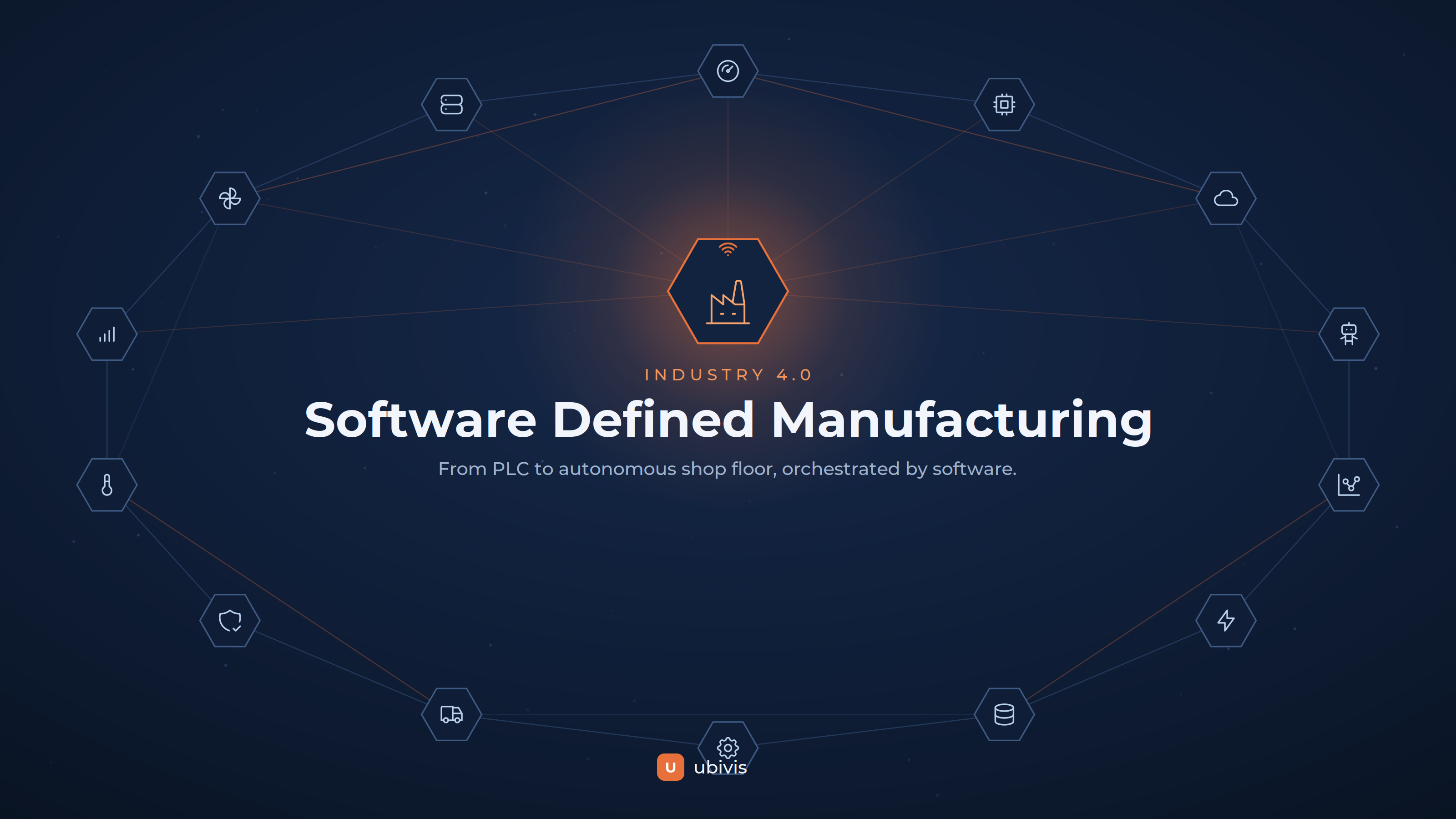
The current focus is SDM, Software Defined Manufacturing. In a traditional factory, the process logic is locked into the physical connection, and changing it requires stopping the line and reprogramming. In SDM, we place a layer of AI between the software and the machines. This layer talks to the PLCs and can adjust process parameters within limits defined by engineering. The factory gains a new kind of flexibility, guided by data and continuous optimization.
Ten years solving the same problem
We went from data collection to digital twin, then to SDM. But the throughline is the same: turning what happens on the shop floor into useful information, in real time, to make better decisions. The difference is that today we can go beyond showing what happened. We can predict, prescribe and, in the case of SDM, act.
In an industry that keeps talking about a revolution every two years, perhaps the most radical thing is exactly this: seeing the factory as it really is, listening to the data it already produces and, from there, going far.